
3 global insights from the 2025–26 school wellbeing trends report
{{centre}}
Beyond the classroom: 3 global insights from the 2025–26 school wellbeing trends report
{{centre}}
{{justify}}
Every year, the Komodo team collates and anonymises the data collected across our global school communities to explore worldwide school wellbeing trends. These data points are then mapped against current psychological literature by our Head of Psychology to provide schools with evidence-backed, actionable recommendations.
{{centre}}

{{justify}}
This Annual Trends Report, featuring data from the 2025-26 academic year has been completely redesigned into an interactive, digestible experience for educators. For the first time, it also features crucial staff wellbeing insights, recognising that positive educator health is the foundation of strong student outcomes and school culture. While the full Annual Trends report is exclusive to Komodo schools, we are sharing a summary of our primary global findings to spark conversation and inspire holistic approaches to student health.
{{justify}}
One: Social Wellbeing - A standout strategic asset
{{justify}}
A standout, consistent strength across our global community is Social Wellbeing. This metric evaluates a student’s peer relationships, social connectedness, sense of belonging, and perceived social support within their school.
High social wellbeing acts as a powerful protective factor. It buffers against stress, strengthens emotional resilience, and provides stability for young people when wider environmental factors feel unpredictable.
What global research tells us
Leveraging high social wellbeing as a foundational strength is one of the most effective strategies a school can employ.
The protective shield: Strong social connections act as a buffer for the nervous system. Students with high peer support recover from emotional setbacks more quickly through validation, belonging, and encouragement from friends. These connections also play a key role in school engagement and attendance. For many young people, friendships are a major reason they want to come to school. When students feel connected, they are more likely to attend regularly, engage in learning, and persist through challenges.
Leveraging social connection for achievement: Because peer influence is a powerful driver of adolescent behaviour, schools with strong social connections can harness positive peer influence to support wellbeing, engagement, and achievement.
Peer-led action: Students are significantly more likely to engage with wellbeing initiatives, positive behaviours, and school activities when they are championed by peers they respect, rather than being introduced solely through top-down staff messaging
Key takeaway for school leaders (Social Wellbeing)
Social wellbeing should not be viewed solely as a wellbeing outcome - it is a strategic asset. Schools that intentionally strengthen peer connection, belonging, and student voice create conditions that support attendance, engagement, resilience, and learning. Rather than asking, "How do we improve student outcomes?" leaders should also ask, "How do we strengthen the relationships that make those outcomes possible?"
{{justify}}
Two: The cyclical challenge: Digital Wellbeing & Sleep disruption
{{justify}}
In contrast, our data identifies Digital Wellbeing and Sleep as the two most critical areas requiring targeted focus globally.
Digital Wellbeing measures how students navigate technology, specifically their balance between online and offline life, and their ability to maintain healthy boundaries in digital spaces.
Our Sleep theme measures the quality, quantity, and consistency of students’ sleep behaviours, recognising its critical role in mood regulation, learning, memory, attention, and emotional wellbeing.
As the lowest-scoring themes globally, they represent significant opportunities for schools to create meaningful improvements in both learning and wellbeing outcomes.
{{justify}}
What global research tells us
{{justify}}
When these areas are compromised, students are more likely to experience difficulties with concentration, emotional regulation, motivation, engagement, and resilience. Over time, poor sleep and unhealthy digital habits can contribute to increased stress, lower academic performance, reduced wellbeing, and challenges in maintaining positive relationships.
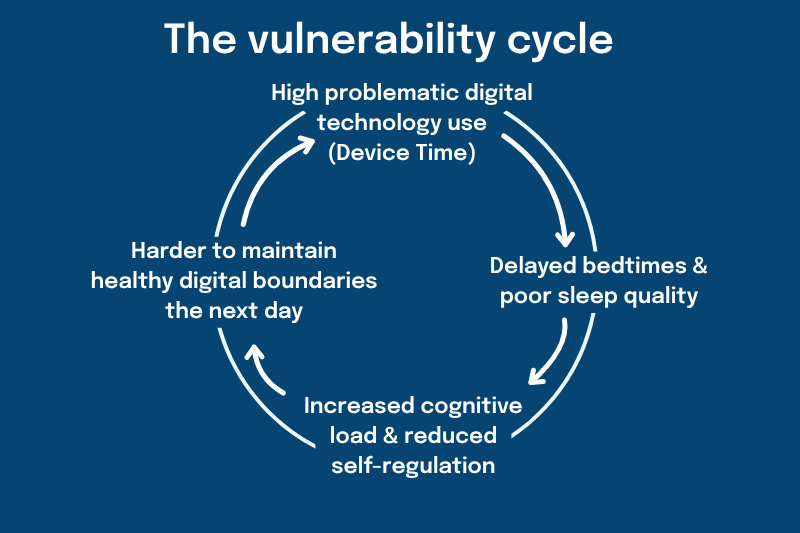
Our data trends match global educational psychology research, illustrating that these two areas do not exist in silos. Instead, they form a highly correlated, cyclical relationship:
The sleep disruption effect: High levels of problematic digital use are associated with delayed bedtimes, longer sleep latency, and reduced sleep quality. As digital engagement increases, sleep is often the first area compromised.
The regulation challenge: Sleep is essential for executive functioning, attention, emotional regulation, and impulse control. When students are sleep-deprived, they are more likely to struggle with concentration, motivation, learning, and behaviour.
The vulnerability cycle: Poor sleep reduces a student's capacity to self-regulate, making it harder to maintain healthy digital boundaries the following day. This can create a reinforcing cycle of increased device use, reduced sleep quality, and declining wellbeing.
Wellbeing factors rarely exist in isolation. Rising behavioural concerns, reduced engagement, lower attendance, or problematic device use are often visible indicators of correlated challenges with sleep and emotional regulation. Schools that address these foundational drivers are more likely to see improvements across multiple areas of student functioning.
Key takeaway for school leaders (Digital Wellbeing & Sleep)
Digital wellbeing and sleep should not be viewed as separate challenges. Our data suggests they can operate as a connected system. While educating students on boundaries around technology remain important, schools are likely to achieve greater impact by pairing these with evidence-based sleep education and self-regulation strategies.
{{justify}}
Three: The new foundation: Staff Wellbeing is Student Wellbeing
You cannot pour from an empty cup. This years new Staff Wellbeing data highlights a critical reality. if you only measure student metrics, you are missing one of the primary drivers of the classroom environment.
When an educator is pushed into a high-stress survival state by unmanageable workloads or rapid role expansion, their capacity to practice co-regulation is naturally compromised.
What is Co-Regulation? The process by which an adult’s calm, supportive presence helps a child regulate their own nervous system and emotional state.
Key takeaway for school leaders (Staff Wellbeing)
Educator mental health is directly tied to school stability and student success. Staff burnout doesn't just impact morale; it creates significant operational friction and high financial costs through absenteeism and teacher turnover. By implementing supportive, anonymous monitoring, leadership teams can identify organisational pressure points early and take visible action to protect their staff.
{{justify}}
Turn insight into action: Download the summary report
We have packaged the core global insights, regional benchmarks, and psychologist-backed recommendations into a concise, school-practical PDF summary. Equip your Senior Leadership Team with the evidence needed to back your pastoral strategy for the upcoming academic year.
{{centre}}

Ready to elevate your school's pastoral care?
Discover how Komodo's psychology-first platform removes the guesswork from student and staff care. Through fit-for-purposesurveys and real-time cohort analytics, we help you spot subtle shifts before they become crises.
Enabling proactive intervention doesn't have to mean adding to your staff's workload. Let us handle the heavy lifting!

